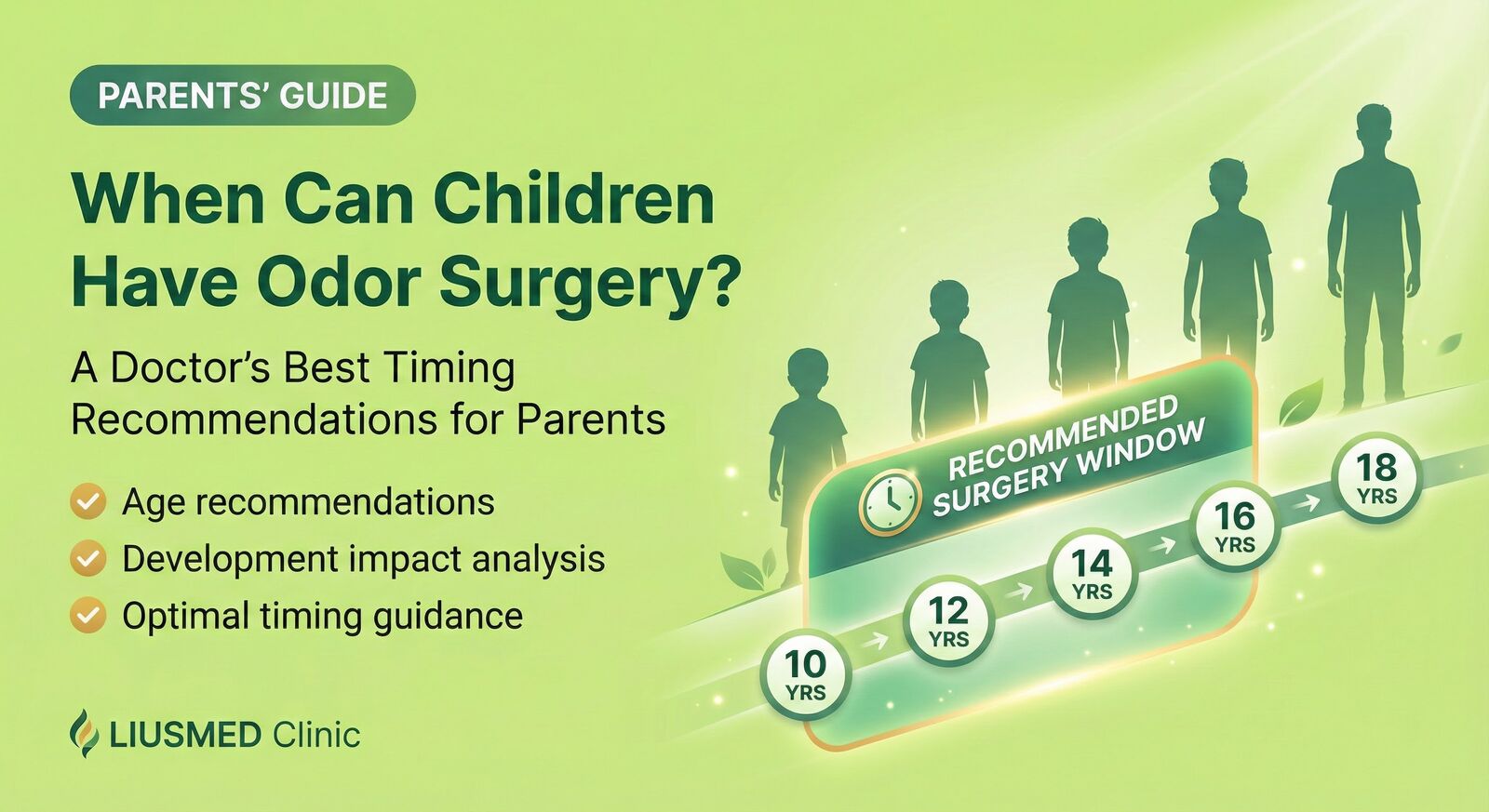
Best Surgery Timing: 10-16 Years
The suitable age for pediatric body odor surgery is 10-16 years, mainly depending on the child's cooperation and psychological maturity. Our clinic's youngest successful case was 9 years old. As long as the child can cooperate with the surgical process, treatment can proceed. This article helps parents understand how to determine the best surgical timing.
Main Consideration for Younger Patients: Cooperation
Apocrine Gland Development Process
| Age Stage | Apocrine Gland Status |
| Childhood (< 10 years) | Not yet activated, usually no odor |
| Early puberty (10-12 years) | Beginning activation, may have slight odor |
| Mid-puberty (12-14 years) | Rapid development, odor becomes noticeable |
| Late puberty (14-16 years) | Development stabilizing |
| Adult (> 18 years) | Fully mature, stable state |
Main Considerations for Younger Patients
| Consideration | Explanation |
| Cooperation | Can lie still for 30-40 minutes to complete surgery |
| Psychological maturity | Can understand the surgical process and follow instructions |
| Communication ability | Can clearly express discomfort |
| Needle acceptance | Can accept local anesthesia injections |
💡 Dr. Liu explains: "Age itself is not the issue—cooperation is key. We have successfully treated 9-year-old patients. As long as the child can cooperate with the surgical process, treatment can be performed safely and effectively."
How to Determine if Your Child is Suitable for Surgery?
Cooperation Assessment Criteria
| Assessment Item | Suitable for Surgery | May Need More Preparation |
| Psychological maturity | Can understand surgery purpose and process | Excessive fear or anxiety |
| Past medical experience | Previous injections/blood draws went well | Extreme needle phobia |
| Communication ability | Can clearly express discomfort | Cannot clearly communicate |
| Staying still | Can lie flat for 30-40 minutes | Cannot stay still |
| Willingness for surgery | Wants to solve the problem themselves | Completely passive |
Age Reference
| Age | Cooperation | Recommendation |
| 9-10 years | Varies by individual | Need careful cooperation assessment |
| 10-12 years | Most can cooperate | ✅ Can schedule surgery |
| 12-14 years | Almost all can cooperate | ✅ Suitable for surgery |
| 14-16 years | Full cooperation | ✅ Suitable for surgery |
Age and Cooperation Relationship
| Surgery Age | Cooperation | Success Rate | Recommendation |
| 9-10 years | Varies by individual | 90%+ | ✅ Need cooperation assessment |
| 10-12 years | Mostly good | 90%+ | ✅ Suitable for surgery |
| 12-14 years | Almost all good | 95%+ | ✅ Suitable for surgery |
| 14-16 years | Full cooperation | 95%+ | ✅ Suitable for surgery |
| > 16 years | Full cooperation | 95%+ | ✅ Anytime |
When Is Surgery Particularly Suitable?
The following situations suggest actively considering surgical treatment:
Suitable Conditions for Surgery
| Condition | Description |
| Odor affecting social life | Excluded by peers, afraid to join activities |
| Obvious psychological pressure | Signs of low self-esteem, anxiety |
| Limited conservative treatment effect | Antiperspirants and other methods can't control effectively |
| Child actively requests | Wants to solve the problem themselves |
| Sufficient cooperation | Can cooperate with the surgical process |
Pre-Surgery Preparation
Before surgery, we recommend the following preparation:
💡 Dr. Liu's recommendation: "As long as the child has sufficient cooperation, surgery can be scheduled at age 10 or above. Our youngest successful case was 9 years old, with excellent surgical results."
What to Do During the Waiting Period?
Temporary Control Methods
| Method | Suitable Age | Effect | Notes |
| Antiperspirant | Any age | Temporary | Choose gentle formulas |
| Deodorant | Any age | Masking | Cannot cure |
| Frequent clothing changes | Any age | Reduction | Stay dry |
| Botox | > 12 years | 4-6 months | Requires repeat injections |
Psychological Support
During the waiting period, parental psychological support is crucial:
Common Parent Questions FAQ
Q1: My child is only 11 with body odor—can they have surgery?
A1: Yes. Ages 10-16 are all suitable for surgery, with the main consideration being child's cooperation. As long as the child can:- Lie still for 30-40 minutes
- Accept local anesthesia injections
- Follow medical staff instructions
Surgery can be scheduled. We recommend coming for a consultation first to assess cooperation, and the doctor will provide individual recommendations.
Q2: How do I know if my child is suitable for surgery?
A2: Mainly assess the child's cooperation:- Can they understand and cooperate with the surgical process
- Have past medical experiences (injections, doctor visits) gone smoothly
- Can they lie still for a period of time
The doctor will interact with your child during consultation to assess their cooperation level.
Q3: Is there a big difference between surgery at 10 vs 14?
A3: The effectiveness is similar, with the main difference being cooperation:| Age | Success Rate | Cooperation |
| 10-12 years | 90%+ | Needs assessment |
| 12-14 years | 95%+ | Usually good |
| 14-16 years | 95%+ | Almost all good |
As long as cooperation is sufficient, surgical results at all ages are excellent.
Q4: My child is being teased for body odor—can we do surgery early?
A4: If your child is experiencing severe psychological pressure from body odor (refusing school, social withdrawal, anxiety/depression), earlier treatment may be considered. Suggestions:Mental health is important—necessary cases can be treated earlier with informed consent.
Q5: Will surgery affect my child's development?
A5: Minimally invasive body odor surgery only treats superficial apocrine glands in underarm skin. It will not affect:- Physical development
- Hormonal system
- Lymphatic system
- Immune function
The surgery itself has no impact on development.
Q6: Is there anything special to note for younger patients?
A6: Mainly focus on cooperation and post-operative care:- Before surgery: Prepare child psychologically, help them understand the process
- During surgery: Our clinic offers gentle IV pain relief to make the process more comfortable
- After surgery: Parents assist with wound care, avoid strenuous activity
Younger children may need more parental assistance with post-operative care.
Surgery Timing Decision Flowchart
Child has body odor
    ↓
How old?
    ↓
┌───────────────┬───────────────┬───────────────┐
│   < 10 years  │   10-12 years │   12-16 years │
└───────┬───────┴───────┬───────┴───────┬───────┘
        ↓               ↓               ↓
    Assess           Assess         Can schedule
    cooperation     cooperation       surgery
        ↓               ↓               ↓
    Sufficient?     Sufficient?     Suitable
    ↓        ↓      ↓        ↓
   Yes      No     Yes      No
    ↓        ↓      ↓        ↓
  Can      Temp   Can      More
  operate  control operate  preparation
            +                  ↓
         Observe        Add psychological
                         preparation
Advice for Parents
1. Consult Early, Assess Cooperation
When your child develops body odor, we recommend early consultation:
- Confirm whether it's body odor
- Understand severity
- Assess child's cooperation
- Discuss best timing for surgery
2. Don't Ignore Psychological Impact
Body odor's psychological impact on pubescent children may exceed parents' imagination:
| Possible Effects | Observable Signs |
| Social withdrawal | Doesn't want to go to school, won't join activities |
| Low self-esteem | Feels "smelly," "dirty" |
| Anxiety | Overly concerned about others' reactions |
| Compensatory behavior | Showers multiple times daily, frequent clothing changes |
3. Decide Together with Your Child
Teenagers need respect. Surgery decisions should:
- Help child understand the problem
- Explain treatment options
- Respect child's wishes
- Set timeline together
Conclusion
| Question | Answer |
| Suitable surgery age? | 10-16 years |
| Youngest case? | 9 years old at our clinic |
| Main consideration? | Child's cooperation |
| Surgery effectiveness? | Excellent results with sufficient cooperation |
| Will it affect development? | No |
Related Reading
- Does Pediatric Odor Surgery Require General Anesthesia?
- Complete Guide to Pediatric Odor Surgery
- Underarm Odor Treatment Comparison: Antiperspirant vs Botox vs Surgery
About the Author
Dr. Liu Ta-Ju- Current Position: Director, Liushi Clinic
- Specialties: Minimal incision surgery (lipoma, cyst), hyperhidrosis surgery, thread lifting
- Experience:
- Over 10,000 successful minimal incision cases
- Board-certified dermatologist
- Philosophy: "Treating pediatric body odor requires considering both development timing and psychological state. I discuss with parents and child together to find the most suitable treatment plan."